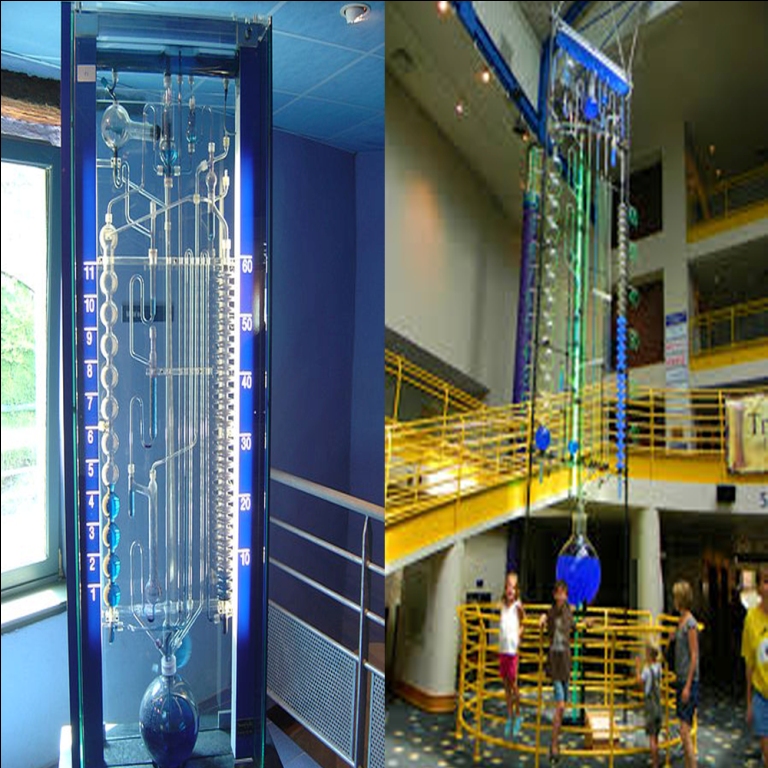
Only a few modern water clocks exist today. In 1979, French scientist Bernard Gitton began creating his Time-Flow Clocks, which are a modern-day approach to the historical version. His unique glass tube designs can be found in over 30 locations throughout the world, including one at Europa-Center's The Clock of Flowing Time in Berlin, Centre Commercial Milenis in Guadeloupe, the Giant Water Clock at The Children's Museum of Indianapolis in Indianapolis, Indiana, and the Shopping Iguatemi in São Paulo and Porto Alegre, Brazil.
Gitton's design relies on gravity powering multiple siphons in same principle as the Pythagorean cup; for example, after the water level in the minute or hour display tubes is reached, an overflow tube starts to act as a siphon and thus empties the display tube. Actual time keeping is done by a calibrated pendulum powered by a water stream piped from the clock's reservoir. The pendulum has a carefully constructed container attached to it; this measures the water that is then poured into the display system.
There are other modern designs of water clocks, including the Royal Gorge water clock in Colorado, the Woodgrove Mall in Nanaimo, British Columbia, in the Abbotsford Airport in Abbotsford, British Columbia, and the Hornsby Water Clock in Sydney, Australia.
Share this Page:
Please Share Your Comments:
Khanewal.com.pk is a comprehensive local portal offering a blend of cultural insights, public service information, and entertainment resources for the Khanewal district.