
Taj Mahal India....... تاج محل بھارت
1 min read
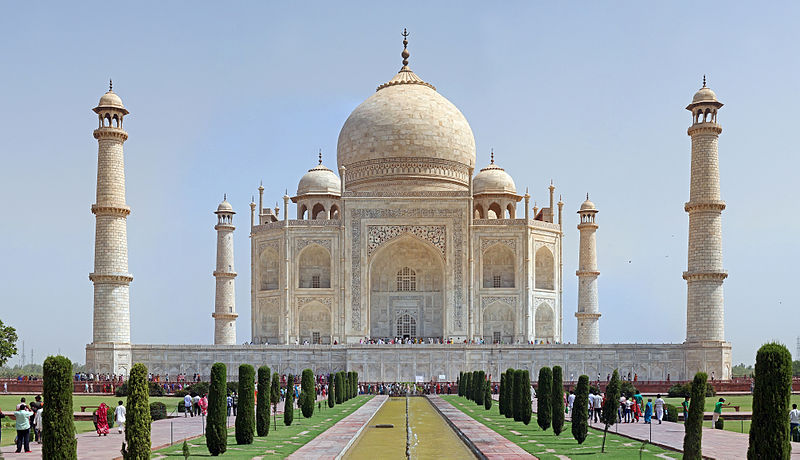
Taj Mahal is regarded by many as the finest example
of Mughal architecture, a style that combines elements
from Islamic, Persian, Ottoman Turkish and Indian
architectural styles.In 1983, the Taj Mahal became
a UNESCO World Heritage Site. While the white
domed marble mausoleum is the most familiar
component of the Taj Mahal, it is actually an
integrated complex of structures. The construction
began around 1632 and was completed around 1653, employing thousands of artisans and craftsmen.
The tomb is the central focus of the entire complex
of the Taj Mahal. This large, white marble structure
stands on a square plinth and consists of a
symmetrical building with an iwan (an arch-shaped
doorway) topped by a large dome and finial.
Like most Mughal tombs, the basic elements
are Persian in origin.
The base structure is essentially a large,
multi-chambered cube with chamfered corners,
forming an unequal octagon that is approximately
55 metres (180 ft) on each of the four long sides.
On each of these sides, a huge pishtaq, or vaulted
archway, frames the iwan with two similarly shaped,
arched balconies stacked on either side. This motif of
stacked pishtaqs is replicated on the chamfered corner
areas, making the design completely symmetrical on
all sides of the building. Four minarets frame the tomb,
one at each corner of the plinth facing the chamfered
corners. The main chamber houses the false sarcophag
i of Mumtaz Mahal and Shah Jahan; the actual graves
are at a lower level.
Comments